Showing posts with label perspective. Show all posts

Sunday, March 30, 2014

Why I'm a Peace Corps Volunteer

Peace Corps focuses on relationships. Of its three main goals, two are about the results of those relationships. It’s about making this world smaller, about connecting people and places. 

I knew nothing about Cambodia when I received my invitation to serve here with Peace Corps, barely even knew it was a country. If I had ever been taught about the Khmer Rouge, I didn’t remember. I stepped off the plane in Phnom Penh full of ignorance but excited to learn.

And I have learned. But more than that, I have loved. I love the people I have met. I love my host family, my work colleagues, my friends, and even my breakfast seller. So when I’m asked when I’m going home and fellow Americans express shock that I could want to stay in Cambodia past my tenure with Peace Corps, I ache. I ache because if I’m getting that question and receiving that surprise, then I haven’t done my job.

Honestly, I doubt my Bachelor’s degree in English Literature can make much of a development difference in Cambodia. But I hope that it can help me put my love for these people into words, to make this world a bit smaller and connect my American family and friends with my Cambodian family and friends. That’s why I’m a Peace Corps Volunteer.

Elie Wiesel, a survivor of a different genocide, posits that peace is found in relationships: “We must not see any person as an abstraction. Instead, we must see in every person a universe with its own secrets, with its own treasures, with its own sources of anguish, and with some measure of triumph.”

Cambodia has been experiencing protests and has had a strong minority of Senate seats unfilled due to those protests since July. I’d wager that not many Americans are aware of that. This world is a large place, and we all end up picking and choosing to whom to extend our attention and empathy. The remaining places are merely ‘the other,’ an abstraction of a place in the world where we barely blink an eye when someone is hurting.

And while I understand these limitations on empathy, I still rage against them. Because when a place – and the people in that place – becomes that ‘other,’ we begin to fail at ‘recognizing the humanity in others,’ at ‘seeing the dignity in every other human being everywhere’ (Desmond Tutu; Kurt Vonnegut).

My Peace Corps experience - my purpose in being here with this agency - is to bring Cambodia to life for my fellow Americans, to ensure that Cambodians get some small measure of Americans’ attention and empathy. To bring my love for these people, this place, to life through stories and pictures. My goal is to have you look into their eyes and realize that these people are not abstractions. They are mothers and fathers and sons and daughters and neighbors and friends and lovers. They are flawed. They are beautiful. They are not projects or objects for the charity of pity. They are human beings the same as you and me.

My hope is that you can love them through me and that that love will change the way you live.


My mother. She goes without much needed medical attention to make sure there's enough money for her grandchildren to be healthy and educated.


My boyfriend. I feel truly calm and happy in his presence. He works as a driver but puts his effort into a community school to increase love of learning in his village.


My niece and nephew. Every time I visit, I am met on the road with shouts of glee and bear hugs. My nephew has watch Mulan 12 times. My niece loves to dance.


My sister and my niece, two of the strongest, most independent women I know. And they look damned good in a dress.


My nephew, a typical teenager: he's at the top of his class, stalks pretty girls on facebook, and is saving up to take a road trip with his friends.


My favorite aunt, seen here laughing hysterically with my best friend. She's a midwife at the same health center where her husband is the director. I love to watch how in love they are.


My friend. He's the main teacher at Countryside Class, which he did for two years on a volunteer basis. He has shared with the students his love of song and dance, and they recently performed and studied in workshops at Create Cambodia.
My boyfriend's niece and the giver of the best hugs in Cambodia. She is one of the funniest and most gregarious kids I've ever had the pleasure of knowing.

My friend and his son at their home in Pursat. He is the most trusted tuk tuk driver in Phnom Penh.


My favorite tuk tuk driver in Siem Reap, who became a great friend when he was the guide for Vaughn, Jessie, and I. He works hard for his parents and siblings and spends as much time as he can helping at an orphanage.


Some of the teachers at my school in Svay Rieng. This picture was taken at a Christmas party they threw so I wouldn't be homesick. They all pitched in so we could eat at my favorite restaurant.


My favorite class of students. They were all good-spirited goofballs. 


Saturday, October 5, 2013

Our Trip to Vannak's


For last year’s Pchum Ben Festival, I and the other Svay Rieng Peace Corps Volunteers ventured by bike to our friend Vannak’s house where we spent the day playing with puppies and piglets and riding water buffalo. (You can read my previous post about this trip here: http://mylifewithrice.blogspot.com/2013/05/this-is-my-friend-vannak-man-not-water.html)

For this year’s Pchum Ben Festival, I and 12 others again visited Vannak and his family, but this time we hit up his in-laws in Pursat Province. In Cambodian culture, once married, the newlyweds will often move in with the bride’s family, so Vannak’s house isn’t with his own family in Svay Rieng where he grew up but in Pursat Province with his wife’s extended family.


Vannak’s wife and her family cooking up a feast for all the guests.


Vannak and his son.

Since Vannak’s house is in an extremely remote village outside of the provincial town, the plan was for him to come in with his District’s ra’mourk (a motorbike pulling a flat trailer) that runs in the morning to allow villagers to get to the major market in the town. Alas, we were foiled by rainy season with pouring, incessant rain from early morning until almost 11. Since the ra’mourk wouldn’t be able to get through in those conditions, we had to find our own transportation. Vannak got us in touch with a neighbor who had taken his motorbike into town, and he helped us find a van to fit all of us. The van-finding, though, was done with protest, since he assured us that nothing larger than a tuk tuk (essentially a motorbike-drawn carriage) would be able to pass on the roads. Frugality prevailed and we ignored his advice, renting a van to take us to Vannak’s house.

The neighbor acted as our driver’s guide, leading us down increasingly poor dirt roads, until we reached a canal running between two narrow paths. We ventured down the first path, stopping short where the road narrowed too much. The second path yielded no more success. So we piled out of the van, thanking our driver for his effort and commitment to the cause, and we walked the remaining two kilometers. Vannak’s village is so entirely remote, that we walked over a kilometer without seeing a single dwelling. His village is what I always envisioned I would live in during my time with Peace Corps, the no electricity, no paved roads, no school buildings type village.


Making the trek on foot after our van could not pass.


Vannak’s back yard.

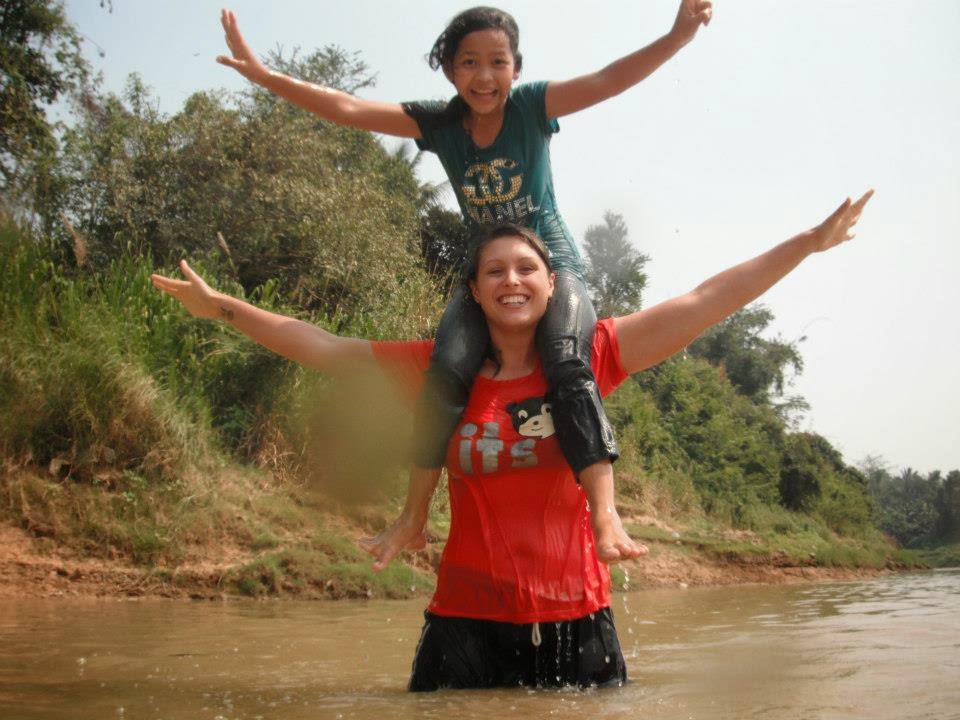
Upon arriving at the home, we greeted everyone in the formal Cambodian manner of placing our palms together, fingers up, and bowing slightly. We chatted with Vannak, and he showed us around the area a bit, taking special note of river where we immediately went swimming while lunch was being cooked. I’m fairly sure we were the first foreigners most of the children had ever interacted with, so we were quite the wary fascination for them, and we had a large crowd examining us during (and after) our swim.


Enjoying the peaceful calm on the river bank before jumping right in.


Tysor’s flock of children.


Me, trying to bond with Vannak’s kid.

Lunch blended seemlessly into hours of socialization. We all chatted together, goofed off, and made new friends. Eventually, the music came out and the dance party started. Thankfully, we got the older ladies of the house to bust a move with us, which is atypical for Cambodian parties, and everyone seemed to get a kick out of it.


Willia and Oum gettin’ down.

Long before we were ready to say goodbye, it came time to leave. The only form of transportation available in the village was a plow modified to run on the road and trailing a large board. We all squeezed on, saying our goodbyes and accepting invitations to return at the next holiday. Two of the guys followed us on a motorbike to ensure our safe return, which ended up being a lifesaver as one of the plow’s tires blew and the motorbike was able to go borrow a tire from a neighboring village (they also proved extremely helpful as retrievers of our shoes and sunglasses that the rough bumps took flying).


Our ‘car’ for the trip back to town.

The strength of Peace Corps comes in the relationships you form. Because of our friendship with Vannak, we were able to meet people and have an experience that otherwise never could have happened. We we able to gain perspective and connections and empathy for a community we otherwise never would have known existed. We didn’t make any difference in anyone’s lives (except maybe provide some amusing tales), but we changed our own lives. It’s hard to live the same way after you’ve been in a village where you had to go to the neighbor’s house because your friend’s house didn’t have a bathroom, where your seemingly easy request for dancing music resulted in a concerted effort to find a music player and car batteries with which to play it, where an obviously poor family found enough meat to add to the vegetables you brought because you didn’t consider that they would feel rude not to provide you with meat for lunch. We’ll never forget our trip to Vannak’s.

Tuesday, September 24, 2013

I live in a post conflict - post genocide - society.

The evidence of destruction and reconstruction are evident at every turn, from the interior administration to the physical landscape dichotomy of bomb-cratered rice fields and newly rising skyscrapers. Mostly, though, the history of Cambodia lies ever present in the skin of survivors.

I’ve talked with my host families about their personal history during the Khmer Rouge. Those talks are always my listening and trying to understand while my mother or father or aunt or neighbor tells a story that needs to be released, needs to be heard by someone - anyone.

Sometimes, though, I’m caught off guard. A statement so shocking, so painful, is given to me in passing conversation, and I simply don’t know how to respond. It’s not just my lack in language ability, it’s my lack as a human not knowing how to absorb and reflect and bear witness to pain so deep shown so freely. I’m afraid that I’m normalizing tragedy and horror.

Last night my neighbor’s aunt was visiting from California. She mentioned that she had come to honor and remember her father, who had died just a few days before Phnom Penh and the majority of Cambodia was liberated by the Vietnamese.

This morning my friend whom I spend every morning chatting with while I wait for my noodles to be cooked told me that he wish that he had been able to study English. Unfortunately, he said, he was 17 when Pol Pot came into power and abolished education. By the time schools resumed, he was too old to study.

I want them to know I’m trying to understand, trying to empathize, but my words are too few.

Sunday, August 18, 2013

Today I made my way to Svay Rieng, taking a very familiar path for the first time in two months. This time, though, I had a unique insight via the only other foreigner (a Chinese man making his way to Vietnam) in the van. Through his experience, his eyes, I was able to project how far I’ve come in this country in the past two years. I think it’s a testament to how much the human body and spirit can adjust.

He was irritated by the wait time at the market and bewildered by the imprecise answers to ‘How much longer?’ ‘When we have enough customers’ was an impractical and indefinite as a structure for business. The stop at the bakery absolutely confounded him. That the ride should be a leisurely pursuit and not an efficient rush was bothersome. He gazed through the windows at Neak Loeung with awe, pity, and disgust at the conditions, beggars, and brazenness of the sellers. And all of this he had to do without communicating with the driver or other passengers (myself excepted since he had some English ability).

I sort of miss experiencing everything so freshly and so internally. I miss the challenge of throwing everything against my Western paradigms, trying to bring my expectations crashing down. I know there are still those walls, but they don’t seem so high, so insurmountable anymore.

Wednesday, May 29, 2013

The Day's Reflection - 22 April 2013

Today I’m waiting for the doctor to call. When he swung by my house on Friday, he told me that he’d stop by again on Monday and that maybe I’d get my stitches out and be cleared to ride my bike. Well, today is Monday. But I don’t know what time he’ll come. Or if it’ll be just another quick cleaning at my house. Or if he’ll take me to town to the clinic. Or maybe he won’t call and won’t come. I don’t know.
If I were in the States, this waiting and the unknown would bother me. Here, though, I’m too ashamed to even consider being bothered. 
First, the doctor has done everything for me for free: xray, debridement, stitches, antibiotic, a ride to my house, and a house call. He says that because I am a volunteer who has come to help his country, he wants to do something to help me. I have failed in my attempts to express how grateful I am to him. 
I recognize what a privilege I have being an American right now. I have the privilege of being able to follow through with the doctor’s orders to rest and not have to work to live. I have the privilege of the extra care my family is giving me since they recognize I am out of my element. I have the privilege of special care from the medical staff (being bumped to the front of the line ahead of people in much worse condition than me, being given a ride home from the clinic, being provided home visits, etc). 
But, mostly, being sick and/or hurt while living with survivors of genocide is drastically perspective shifting. Keeping my barely-injured knee elevated while my mother tells stories of life in the Khmer Rouge and my father stretches out his leg scarred from the war…well, I can’t really express what that does to one’s paradigm of pain and health and life moving on.